


CriticJEPA
World models are better critics than optimizers.
1Tsinghua University 2Zhongguancun Academy 3Manifold AI
*Equal contribution †Corresponding authors
H-JEPA pathCriticJEPA pathstartgoal
Visual AntMaze evaluation tasks from the paper, run with H-JEPA's own settings: the same frozen three-level world model, the same start, the same goal and the same 350-step budget. Seen from above, re-rendered from the recorded joint states.
across four environments. Pick one to watch.
Judge the plans.
Don't optimize them.
Planners improve a plan by following the world model's gradients. After a few steps, the plan gets better only in the model's eyes. In reality it stalls.
Asked to compare finished plans, the frozen model ranks them well, as long as the plans are aimed at the goal.
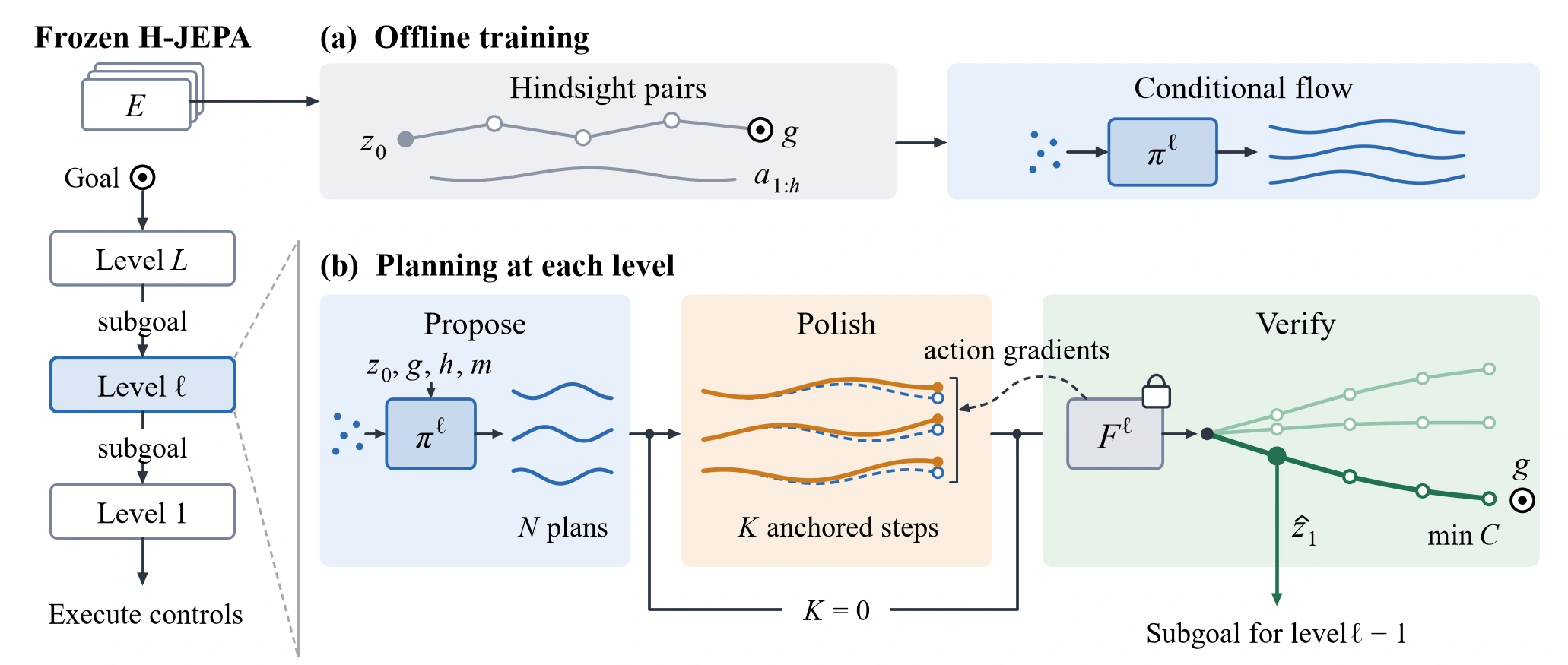
A small flow head writes goal-directed plans. The frozen world model only picks among them. Nothing in the world model is retrained.
Better everywhere.
For a fraction of the compute.
H-JEPACriticJEPA-5Planning compute
Success rate averaged over three independently trained world models per row, with one shared set of planning settings. CriticJEPA-0, which uses no gradient steps at all, also beats H-JEPA in all six rows: 78.7, 52.0, 18.7, 100, 100 and 100.
Why it works.
Every plan below is actually executed from the same saved simulator state, so prediction and reality can be compared plan by plan.
The model already knows the way.
Run H-JEPA three times on the same 50 tasks with the same frozen model. Each run solves about 72%. Together they solve 92%. The route is there. A single gradient search just does not find it reliably.
solved failed
Search learns to fool the model.
At 720 saved AntMaze states we let gradient search run for 0, 10, 30 and 90 steps, then executed every result. After the first 10 steps, the error the model predicts keeps falling while the error the agent reaches stops improving.
Lower is better. The green line is CriticJEPA-0: choosing among 100 proposals with no gradient steps at all beats every amount of search.

Write the predicted cost as the true cost minus the model's error ε. Every gradient step follows both directions, and nothing stops it from following the second. The trace is visible in the maze: failed runs put their subgoals near or inside walls about twice as often.
A good judge needs good options.
We asked the same frozen model to pick the best of eight plans and executed all eight. On search outputs it picks at chance. On plans retrieved from data it ranks best, yet its pick ends far from the goal. On goal-conditioned proposals it ranks well and its pick lands closest.
The world model is a reliable critic.
It just should not be the one writing the plans.
Propose. Polish. Select.
At every level of the hierarchy, from distant subgoals down to motor commands.
A small flow head, trained on reward-free trajectories, samples a batch of plans aimed at the current goal.
Optionally, a few gradient steps tidy each plan, anchored so it stays close to where it started.
The frozen world model imagines every candidate and keeps the one predicted to land closest to the goal.
Spend compute on choices.
Proposing and comparing is cheap. Long gradient search is not, and it chases the model's mistakes.
Visual AntMaze: success vs compute
On 50 extra tasks generated after the method was finalized: 74.7% for H-JEPA, 92.0% for CriticJEPA-5.
Polish, but briefly
Two anchored steps help most. More steps give some back, as Finding 2 predicts.
Watch it plan.
Navigation, contact-rich pushing, manipulation and room-to-room navigation with a distractor. Same recipe, same settings.
Read the paper.
Exact-state diagnostics, ablations across every hierarchy level, budget sweeps and all implementation details.
Citation
@misc{liu2026criticjepa,
  title  = {CriticJEPA: World Models Are Better Critics Than Optimizers},
  author = {Liu, Xvyuan and Fang, Jianjie and Zhang, Honglin and Wang, Zhaolu and
            Zhang, Xin and Wu, Wei and Xu, Fengli and Gao, Chen and Li, Yong},
  year   = {2026},
  note   = {Preprint}
}